Morgan Stanley analyst sends urgent S&P 500 message
👤Mwangi Enos
(5 hours ago)
🎯
Stockseer AI Analysis
Deep market context with technical indicators, price levels, and actionable insights
Morgan Stanley’s pivot to a bullish 7,800 S&P 500 year-end target signals a potential trend reversal from recent bearish earnings sentiment, acting as a macro tailwind for high-beta tech names like **MSFT** and **NVDA**. While the index faces immediate overhead resistance at the 6,525-6,550 zone, the underlying 14% EPS growth forecast provides a fundamental buffer against current elevated Treasury yields. Technical indicators for **MSFT** (RSI: 39.17) suggest the stock is oversold within a broader consolidation, while its bullish MACD crossover indicates emerging momentum that could trigger a move toward the $390 resistance level if broad market sentiment improves. Conversely, **MS** stock remains in a cautionary zone (MACD bearish, 0.87x volume), highlighting a divergence where the firm’s macro strategy is more optimistic than its equity-specific technical setup. Traders should treat this as a tactical "buy the dip" opportunity on the S&P 500, but utilize the 6,525 technical barrier as a prerequisite for aggressive scaling, as a failure to clear this level would confirm a volume vacuum risk that could drag the broader market back toward recent lows.
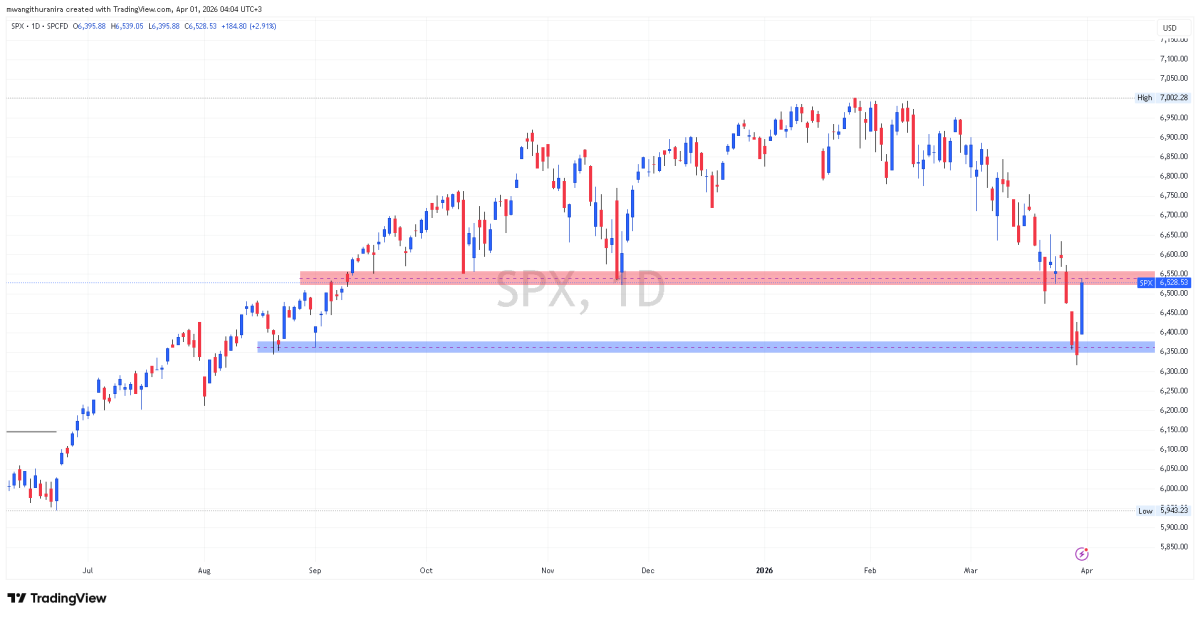
The S&P 500 just proved the bears wrong, and the worst may be over. After weeks of pressure tied to rising oil prices and escalating tensions in the Middle East, stocks suddenly surged. S&P 500 jumped nearly 3% to close at 6,528.52 on March 31, marking its strongest day in weeks.
So what changed? Behind the scenes, one of Wall Street’s most closely followed strategists is signaling a potential turning point. But while the recent rally offers hope, it comes with a clear warning investors may not want to ignore.
Is this the beginning of a recovery or just a temporary bounce before another move lower? Let's find out.
S&P 500 correction may be nearing its final stage
According to Morgan Stanley strategist Michael Wilson, the current market correction could be entering its final phase.
Wilson and his team point to growing evidence that much of the downside may already be priced in.
More than half of the stocks in the broader Russell 3000 are down over 20% from their highs. A sign of widespread market pain. At the same time, the S&P 500’s forward price-to-earnings ratio has dropped sharply, reflecting increased caution among investors.
In a CNBC note published in late March 2026, Scott Rubner, currently the Head of Equity and Equity Derivatives Strategy at Citadel Securities, noted that the S&P 500's forward price-to-earnings (P/E) ratio had fallen to 19.7
That combination, Wilson argues, mirrors past “growth scare” periods that did not end in recession.
So the market may really be saying, one, Investors are no longer overly optimistic. Two, risks tied to global growth are being priced in, and third, the correction may already be well advanced.
Even the recent surge in oil prices, driven by the ongoing conflict involving the Strait of Hormuz, appears to be partially reflected in current valuations. And interestingly, defensive sectors like consumer staples have underperformed since the conflict began. That suggests that investors aren’t fully bracing for a worst-case scenario.
Middle East tensions and oil prices reshape market outlook
The geopolitical backdrop has been impossible to ignore. Rising tensions involving Iran have disrupted global energy flows, pushing Brent crude above $116 per barrel at one point on March 30th, as per Trading Economics . That kind of spike would typically trigger fears of a broader economic slowdown.
But this time looks different. Why?
Wilson highlights that earnings per share (EPS) growth remains strong. Currently running at about 14% year-over-year and even accelerating. In past cycles where oil shocks ended economic expansions, earnings were already weakening. This time, they’re not.
The increase in oil prices, while significant, is also less extreme than in previous crises. That suggests the market may be viewing the situation as temporary rather than structural.
And then came a major shift in sentiment.
Reports that Iranian President Masoud Pezeshkian may be open to ending the conflict helped bring light at the end of a tunnel in relation to the broad market rally. The Dow Jones Industrial Average surged over 1,100 points, while the Nasdaq Composite jumped nearly 4%.
Still, not everyone is convinced the danger has passed. Is this a real recovery or just a relief rally? The answer lies in what happens in the next few sessions.
Interest rates emerge as the biggest risk for stocks
While geopolitical fears may be easing, Wilson says the real threat could come from somewhere else entirely. Interest rates.
The benchmark 10-year Treasury yield is approaching 4.5% as per CNBC. A level that has historically pressured stock valuations. When yields rise, equities often struggle as borrowing costs increase and future earnings become less attractive.
Right now, the relationship between stocks and yields has turned sharply negative. That means markets are highly sensitive to rate movements.
And there’s another twist. Markets are beginning to price in the possibility of a rate hike from the Federal Reserve, even as Morgan Stanley economists still expect rate cuts.
Speaking to an economics class at Harvard University on March 30, Powell said inflation appears stable, suggesting the Fed may not need to raise interest rates in response to oil prices. He added that the current rate level is “a good place” as policymakers monitor the effects of the war and tariffs on inflation.
Wilson puts it bluntly: rates are now one of the most important variables you need to watch.
What comes next for the S&P 500?
Despite the risks, Morgan Stanley is sticking with a bullish base case. The firm maintains a year-end target of 7,800 for the S&P 500, provided a recession is avoided.
And there are some encouraging signs.
The so-called “Magnificent 7” tech stocks are now trading at valuations similar to defensive sectors, despite offering significantly stronger growth. That could make them attractive again after months of consolidation.
At the same time, crowded trades in areas like memory chips are beginning to unwind. A process Wilson sees as necessary for a healthier market recovery. Looking at technicals, the S&P 500 is now testing a key resistance zone between 6,525 and 6,550.
To start with, a break and close above the resistance could confirm the start of a recovery. On the other hand, a rejection at the resistance level could send the index back toward the 6,340 support level.
Treasury yields will likely dictate short-term direction. If this is the start of a new recovery rally and the end of the correction, as Morgan Stanley says, then we need to see bullish buildup around these levels for confirmation.
Morgan Stanley strategist Michael Wilson suggests the S&P 500 correction may be nearing its end, providing a bullish outlook for the remainder of the year with a target of 7,800. While acknowledging the risk of rising Treasury yields and geopolitical tensions, the note cites strong 14% EPS growth as a fundamental buffer. Traders should monitor the 6,525-6,550 resistance zone as a critical technical indicator for confirmation of this recovery trend.
PublishedApril 1, 2026 at 6:47 PM Fresh - Highly Relevant
AI Confidence80%High
ImplicationPotential upside for related securities
Disclaimer: This analysis is for informational purposes only and should not be considered financial advice. Always consult with a qualified financial advisor before making investment decisions.